
🔋 The Ultimate Guide to the Battery Capacity Tester 9‑99V 20A — Overview, Specs, Real Use, Pros & Cons, Comparison, FAQs & More
Unlock accurate battery testing for lithium‑ion, lead‑acid, and other battery types with an advanced capacity tester built to handle voltages from 9 to 99 volts and currents up to 20 amps.
This comprehensive article gives U.S. buyers all the insights needed before purchase — from how the tool performs in real life to what sets it apart in a crowded market.
📌 What Is a Battery Capacity Tester?
Battery capacity testers are specialized instruments used to measure how much usable energy a rechargeable battery can store and deliver under controlled conditions. Unlike simple battery checkers that estimate voltage or remaining charge, a capacity tester conducts controlled charge/discharge cycles and calculates actual battery capacity in amp‑hours (Ah). This makes them indispensable for battery technicians, EV service shops, solar installers, hobbyists, and battery manufacturers.
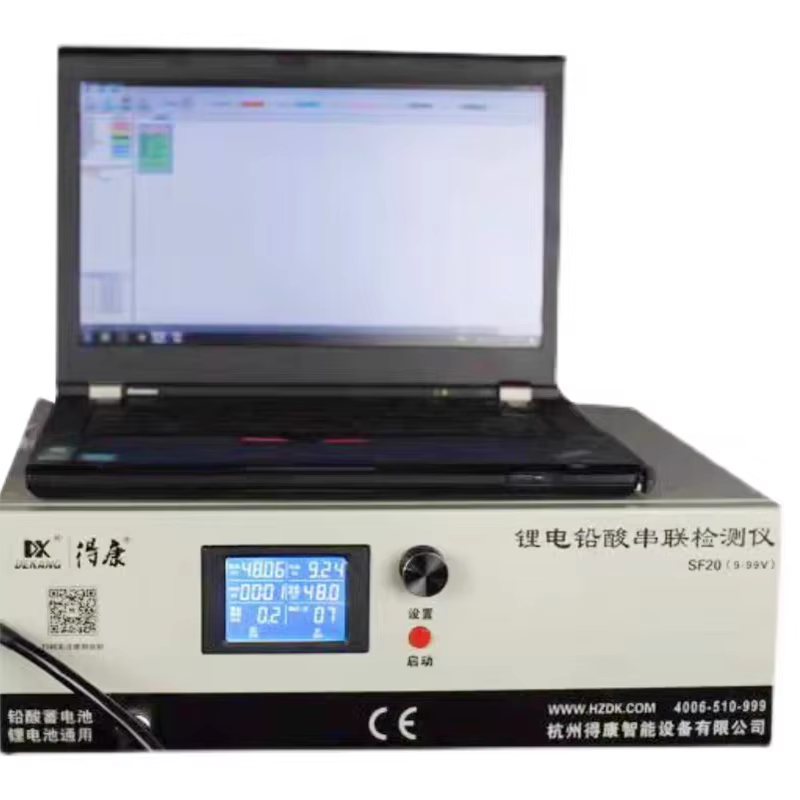
🧰 Product Overview — Battery Capacity Tester 9‑99V 20A
This professional‑grade battery tester supports a wide voltage range from 9 V up to 99 V, making it suitable for everything from mid‑range EV battery packs to large lead‑acid battery banks used in renewable energy systems. It also handles discharge currents up to 20 A, allowing accurate capacity estimation under load.
Key Highlights
- Voltage Compatibility: 9 V — 99 V
- Current Range: Adjustable discharge up to 20 A and charge up to roughly 10 A (model dependent)
- Battery Types Supported: Lithium‑ion, lead‑acid, nickel‑based, and other rechargeable chemistries
- Operation Modes: Direct panel operation or PC control for automated tests
- Use Cases: Capacity testing, duty cycle analysis, battery performance diagnostics, research labs
This unit is commonly sold online through marketplaces like AliExpress and other international suppliers targeting global hobbyists and professionals.
🧠 Real Use / Experience — What Buyers Actually Do With It
Many technicians and professionals rely on capacity testers like this for:
▶️ Battery Performance Validation
Rather than guessing battery health from voltage alone, professionals use this tester to discharge batteries under controlled current and measure exactly how much capacity they hold. This avoids common pitfalls like overestimating battery life based solely on idle voltage.
▶️ EV and E‑Bike Battery Testing
Because many mid‑range e‑bikes and small electric vehicles run around 24 V to 72 V, this tester is a great fit for diagnosing pack degradation and estimating remaining usable energy. The wide voltage range makes it a versatile choice.
▶️ Recondition & Return Testing
Battery refurbishers use controlled discharge tests to profile used batteries before re‑selling or reconditioning them — allowing them to grade batteries accurately.
▶️ Lab and Production Use
Some manufacturers use this tester to simulate real charge/discharge cycles during production QA, ensuring each pack meets performance expectations before shipment.
📊 Features & Specs — What You Need to Know
Here’s a detailed breakdown of typical features and technical specifications found on 9‑99V battery capacity testers in this class:
💡 Electrical Specifications
| Feature | Specification (Typical) |
|---|---|
| Voltage Range | 9 V — 99 V adjustable |
| Maximum Discharge Current | Up to 20 A |
| Charge Current (Approx.) | Up to 10 A |
| Operating Power | ~900 W AC input with built‑in power conversion |
| Protection Features | Reverse polarity, over‑voltage, short circuit protection |
| Cycle Testing | Up to ~16 cycles (depends on model) |
| Interface | Panel controls and optional PC software via LAN |
🛠 Built‑In Safety & Design
- Modular design for easy maintenance
- LCD or panel display for real‑time data
- PC connectivity for detailed logging and graph exports
These testers are typically rugged and designed for professional environments where repeatability and safety are crucial.
👍 Pros & 👎 Cons
Every tool has strengths and limitations. Here’s a balanced look to help you decide:
✅ Pros
✔ Wide Voltage Compatibility: Works from low‑voltage packs up to near 100 V, covering many industrial and automotive applications.
✔ Accurate Load Testing: Offers true capacity measurements under controlled conditions.
✔ Useful for Multiple Chemistries: Not limited to a single battery type.
✔ Cycle Test Capability: Supports repeated charge/discharge cycles.
✔ PC Software Support: Enables data logging and reporting — great for professional diagnostics.
❌ Cons
✘ Higher Price Point: More expensive than casual handheld battery testers — oriented toward professionals.
✘ Learning Curve: Full capability requires some understanding of battery chemistry and testing protocols.
✘ Power Requirement: Needs a stable AC power source, not portable like smaller battery checkers.
⚔️ Comparison — How It Stacks Up
To give perspective, let’s compare the 9‑99V 20A capacity tester with other battery testers commonly used in the U.S.:
| Feature | Battery Capacity Tester 9‑99V 20A | Basic Handheld Battery Tester | Multichannel Cell Tester |
|---|---|---|---|
| Voltage Range | 9 V — 99 V | Often < 20 V | < 5 V per cell |
| Current Output | Up to 20 A | < 3 A | < 3 A |
| Capacity Measurement | Yes (Ah) | No | Limited |
| PC Logging | Yes | Rare | Rare |
| Best For | Professional / High Powers | Home battery checking | Small cells only |
| Portability | Low | High | High |
This comparison shows why professional testers like the 9‑99V 20A unit are preferred for high‑voltage battery packs in EV, industrial, or production use.
❓ Frequently Asked Questions (FAQs)
Q: Can this tester really measure battery capacity (Ah)?
A: Yes — unlike simple voltage testers, this device discharges the battery at a set current and measures how much energy it delivers before cutoff. That’s the true capacity.
Q: What types of batteries can it test?
Most models support lithium‑ion and lead‑acid packs, and many allow adjustment for other rechargeable chemistries — so long as the voltage falls within 9 to 99 V.
Q: Is this device suitable for EV batteries?
Yes — if the battery pack falls within the supported voltage range, this tester can be used for discharge capacity measurements and diagnostics.
Q: Do I need a computer to use it?
No. It typically has a built‑in panel interface, but connecting to a PC unlocks advanced logging and reporting features.
Q: How safe is it to use?
Safety features like reverse polarity protection and over‑temperature shutdown help prevent damage during testing — but standard electrical safety precautions should always be followed.
📈 Best Practices for Battery Testing
To get reliable results:
- Fully charge the battery before testing.
- Set appropriate current based on battery size.
- Ensure connections are clean and secure.
- Monitor temperature — excessive heat can skew results.
🛒 Call To Action — Get Yours Today!
Ready to take your battery diagnostics to the next level? The Battery Capacity Tester 9‑99V 20A gives you high‑precision performance, wide voltage support, and professional‑grade features needed for accurate capacity testing.
Whether you’re a professional tech, EV enthusiast, solar installer, or battery hobbyist, this tool brings industrial‑level testing within reach.
🚀 Final Thoughts
🔍 Understanding the Importance of a Battery Capacity Tester 9‑99V 20A
In the world of battery testing, not all tools are created equal. If you require detailed capacity analysis beyond simple voltage checks, a 9‑99V 20A capacity tester is a powerful solution — offering reliable results, flexible application ranges, and advanced connectivity for data logging and reporting.
This product bridges the gap between consumer battery checkers and lab‑grade equipment, making it a smart investment for anyone dealing with rechargeable batteries on a regular basis.
